





Cutting the cord usually refers to cancelling cable, but recently the phrase implies severing the literal power cable tethering our screens to the wall. Freedom defines modern entertainment, yet anxiety over power levels often ruins the vibe. We constantly check percentages, wondering if the screen will go dark right at a cliffhanger. Let us explore real-world power needs to see if four hours truly suffices.
What Does “Good Enough” Battery Life Mean?
When consumers ask about battery life on a battery tv, the question rarely concerns technical specifications or milliamp-hours. Instead, the query addresses a specific anxiety: Will the device die before I finish viewing content? "Good enough" is subjective, relying entirely on the context of the viewing session.
For a casual viewer, "good enough" might simply mean the duration of a standard Hollywood movie, typically running between ninety minutes and two hours. If the device manages that limit with power to spare, the user remains satisfied. However, a sports fan defines "good enough" differently. A standard NFL game broadcasts for roughly three hours and twelve minutes. A Major League Baseball game averages around three hours. If a portable tv taps out at the two-and-a-half-hour mark, the unit fails the primary purpose, regardless of how sleek the hardware looks.
Manufacturers often list maximum runtimes based on 50% volume and 50% brightness. Real-world usage, however, often demands 100% brightness to combat sunlight on a patio, or higher volume to cut through the noise of a sizzling grill. Therefore, "good enough" usually requires a buffer. A four-hour rating might only deliver three hours of high-performance viewing, which sits right on the edge of acceptability for many users.
What Users Actually Say About 3–4 Hours of Battery Life on a Portable TV
Scouring user reviews and forum discussions reveals a distinct pattern in how owners perceive battery limitations. Surprisingly, few people expect an all-day battery life similar to a smartphone. The physical constraints of a large, bright touch screen tv monitor are generally understood.
The frustration arises not from the total duration, but from the interruption of flow. Users frequently mention the annoyance of having to drag an extension cord across the floor mid-movie. A common sentiment suggests that three hours feels "stressful," while four hours feels "safe." That extra hour provides a psychological safety net. The cushion represents the difference between finishing a director's cut film and scrambling for a charger during the climax.
Users also differentiate between active and passive viewing. When utilizing the screen for background noise or music, power drains slower, and expectations loosen. However, for focused gaming or cinema, the demand for consistent power delivery increases. Reviews consistently praise devices that offer quick charging or the ability to operate indefinitely while plugged in, essentially turning the unit into a standard television when the battery runs low. Understanding the technology behind fast charging can help you appreciate this convenient feature. The consensus holds that while three hours serves a minimum function, four hours acts as the baseline for a truly wireless experience.

Apolosign PackGo 27" Briefcase Portable TV
Portable Smart TV Use Cases: Kitchen, Bedroom, Backyard, Home Office
Different environments impose different energy demands. In a home office, the screen often serves as a secondary monitor or a dashboard. Here, battery life matters less because outlets usually abound. The primary value comes from a portable smart tv acting as a floating screen for data, news, or background noise.
The kitchen presents a unique challenge. Cooking creates a dynamic environment where hands are messy and outlets are often occupied by blenders or air fryers. A kitchen tv must operate completely wirelessly to be useful. A user might spend two hours preparing meals and cooking, followed by an hour of eating and cleaning. A three-hour battery barely covers the session.
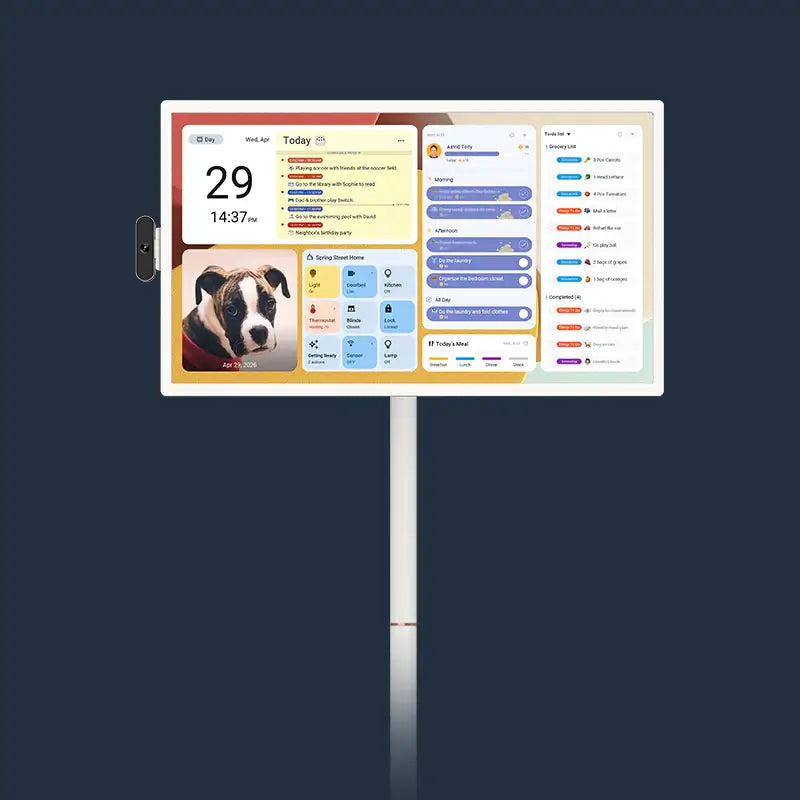
Consider the Apolosign 32" Smart Portable TV. The design specifically addresses such high-traffic areas via a five-wheel mobile stand that allows for smooth gliding between the island and the dining table. With a 15000mAh battery system, the unit offers up to six hours of cordless use. That duration effortlessly covers even the most elaborate Sunday dinner preparation. Furthermore, the integration of Android OS 15 allows cooks to pull up recipes or YouTube tutorials instantly. Because the unit features Google Voice Assistant and Gemini AI, users can control playback or ask for measurement conversions without washing their hands to touch the screen. The choice between a sharp 1080p VA panel or a stunning 4K resolution guarantees the food channels look crisp, while the height and tilt adjustments keep the screen visible whether the user is chopping vegetables or sitting at a breakfast bar.
In the bedroom, the use case shifts to relaxation. Viewers often want to watch a few episodes of a show before sleep. Here, a portable smart tv on wheels replaces the need for a permanent wall-mounted fixture. The ability to roll the screen to the foot of the bed or a reading nook offers flexibility. If the battery lasts only three hours, the user must remember to plug the unit in every single night, adding a chore to the bedtime routine. A device pushing five or six hours allows for two or three nights of viewing on a single charge, significantly improving the user experience.

Where Four Hours Is “Plenty” — and Where It Starts to Feel Tight
Four hours of battery life occupies a "Goldilocks" zone for indoor usage but often falls short for outdoor adventures. For a backyard barbecue or a pool party, four hours typically covers the main event. Guests arrive, music plays, perhaps a game is on, and the event winds down.
However, the equation changes completely when leaving the property. Camping trips, tailgating, and beach days strip away the safety of nearby wall sockets. In such scenarios, a portable tv for camping essentially becomes the primary entertainment hub. If the trip lasts a weekend, four hours of total runtime forces the user to ration entertainment severely.
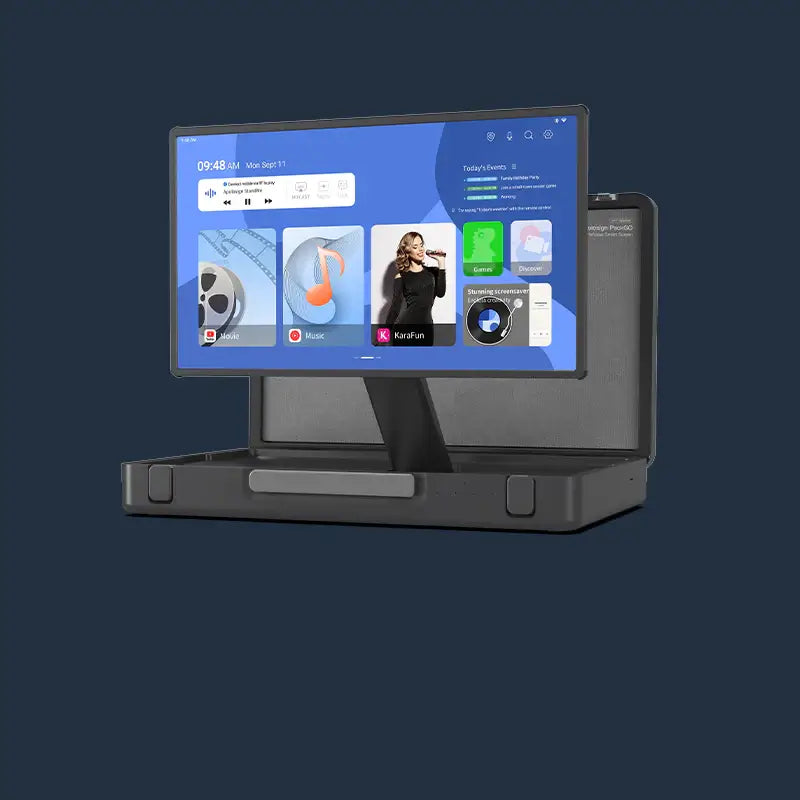
Here is where specialized hardware creates a massive advantage. The Apolosign PackGo 27" Briefcase Portable TV reimagines the form factor for rigorous demands. Instead of a rolling stand, the device folds into a durable briefcase, protecting the 27-inch Full HD display during transport. When opened, the built-in 6800mAh battery provides up to six hours of playtime, surpassing the typical four-hour threshold.
Crucially, the PackGo acknowledges that modern users carry multiple devices. The battery system can output power via USB-C (up to 45W), capable of charging smartphones or even powering a Nintendo Switch. For a camper, the device serves double duty: a high-quality entertainment screen with a 40W quad-speaker system for booming outdoor audio, and a power station for other gadgets. The 450 nits of brightness helps cut through outdoor glare, and the rugged briefcase design means the unit can sit on a picnic table or tailgate without fear of tipping over. In that context, four hours would feel tight, but the PackGo’s six-hour capability, combined with utility as a charging hub, offers true freedom. Learning about the full capabilities of a modern smart display can help you make the most of your investment.
How 4 Hours Compares: 3h vs 4h vs 6–8h Portable TV Batteries
Understanding the market landscape helps contextualize the numbers. The first generation of portable monitors and rolling TVs struggled to hit the three-hour mark. Battery technology is heavy and expensive, leading early manufacturers to compromise.
- 3 Hours or Less: Such a category includes many entry-level generic brands. These devices are essentially "room-to-room" movers. They survive the trip from the living room to the patio but need to find a plug almost immediately. They are not truly wireless; they are merely unplug-able.
- 4 Hours: The duration has become the industry average for mid-range devices. It covers the "Titanic test" (can the screen play the movie Titanic in one go?). It suffices for most indoor tasks but requires discipline regarding charging habits.
- 6 to 8 Hours: The tier represents the best portable tv performance currently available without external battery packs. Devices like the aforementioned Apolosign 32" Smart Portable TV and the PackGo fall into the category. Reaching six hours changes user behavior. Charging becomes an occasional necessity rather than a constant worry. At six hours, a user can watch the morning news, use the screen for a workout video, look up a recipe for lunch, and still have power left for a movie in the evening.
Technical factors influence the numbers heavily. A 4K screen, such as the optional resolution on the Apolosign 32", pushes more pixels and consumes more power than a 1080p screen. However, Apolosign compensates with a massive 15000mAh battery to maintain that six-hour benchmark. Similarly, the PackGo utilizes a highly efficient RK3588 processor to manage energy consumption effectively, balancing high-performance audio and visual output with endurance.

Trade-Offs: Weight, Price, and Screen Quality vs Battery Life
Why do manufacturers not simply install massive batteries to guarantee 24-hour runtimes? The answer lies in physics and ergonomics. Batteries are dense and heavy. Adding capacity directly increases the weight of the unit.
For a portable smart tv on wheels like the Apolosign 32", weight is less of a concern because the five-wheel base supports the load. The engineering challenge involves balancing the center of gravity so the unit remains stable when tilted or rotated 90 degrees into portrait mode. The 15000mAh battery adds heft to the base, which actually aids stability, acting as an anchor.
For a carry-style device like the PackGo, weight is critical. Users must lift and carry the briefcase. Creating a device that lasts 20 hours might render the unit too heavy to be comfortably portable. The PackGo strikes a balance, keeping the form factor slim (4.54 inches deep) and manageable while delivering superior audio and battery life.
Price also plays a significant role. High-density lithium-ion cells cost money. Increasing battery capacity raises the retail price. Furthermore, higher screen quality drains power faster. An OLED or a high-brightness VA panel requires more energy than a dim, low-contrast screen.
The Apolosign 32" tackles the trade-off through offering a high-contrast VA panel (3000:1 for the 4K model) that delivers deep blacks and vivid colors, powered by a battery substantial enough to support the display. The device avoids the "dim screen" trick that some manufacturers use to inflate battery stats. Similarly, the PackGo offers 450 nits of brightness—significantly brighter than many laptops—prioritizing visibility in outdoor settings over maximizing battery life artificially.

A Simple Checklist to Decide If Four Hours of Battery Life Is Enough for You
Determining if you can live with a four-hour limit or if you need the six-hour endurance of an Apolosign device requires an honest assessment of your habits. Use the checklist below to determine your needs.
You likely need 6+ hours (Apolosign territory) if:
- You camp or tailgate: Access to power is unreliable, and the device serves as the main event. The PackGo’s briefcase design and Switch-charging capability fit here perfectly.
- You are a "background watcher": You leave the TV on for noise while cleaning, working, or exercising for long periods.
- You hate cables: You want the device to live in the center of a room, away from walls, for days at a time.
- You watch live sports: Overtime or extra innings can easily push a broadcast past the four-hour mark.
- You use the device for productivity: Using the screen as a secondary monitor for a full workday requires substantial endurance.
Four hours might be acceptable if:
- You only watch one movie at a time: You have a specific viewing purpose and turn the unit off immediately after.
- You stay indoors: You are never more than twenty feet from an outlet.
- The device lives on the charger: You only unplug the unit for very short durations, such as showing a funny video to a family member in another room.
Why 6-Hour Battery Life Is the Sweet Spot for Portable TVs
"Good enough" battery life is the point where you stop thinking about the battery icon in the corner of the screen. While four hours covers the statistical average of a single viewing session, the limit leaves little room for error, extended director's cuts, or spontaneous double-features. Devices like the Apolosign 32" Smart Portable TV and the PackGo 27" Briefcase Portable TV push the boundary to six hours, transforming the experience from "manageable" to truly liberating. Whether rolling through the kitchen or opening a briefcase at a campsite, that extra capacity provides the peace of mind that defines a premium portable experience.