



This article explores how the Apolosign PackGo 27" Briefcase Portable TV can be used as a large, stable external display for drone monitoring, improving real-time visibility and field decision-making.
As commercial drone operations become increasingly standardized, one often overlooked but critical factor is emerging as a core performance bottleneck: the quality of the on-site monitoring display.
Whether it is roof inspections, infrastructure surveys, or aerial event coverage, drone operators rely heavily on real-time visual feedback to evaluate framing, distance, and fine structural detail.
A large external drone monitor can make field operations easier by giving pilots and observers a clearer view of live footage than a smartphone or tablet. For inspections, surveys, and event coverage, screen size, HDMI stability, battery life, and outdoor visibility all affect how accurately operators interpret the drone feed.

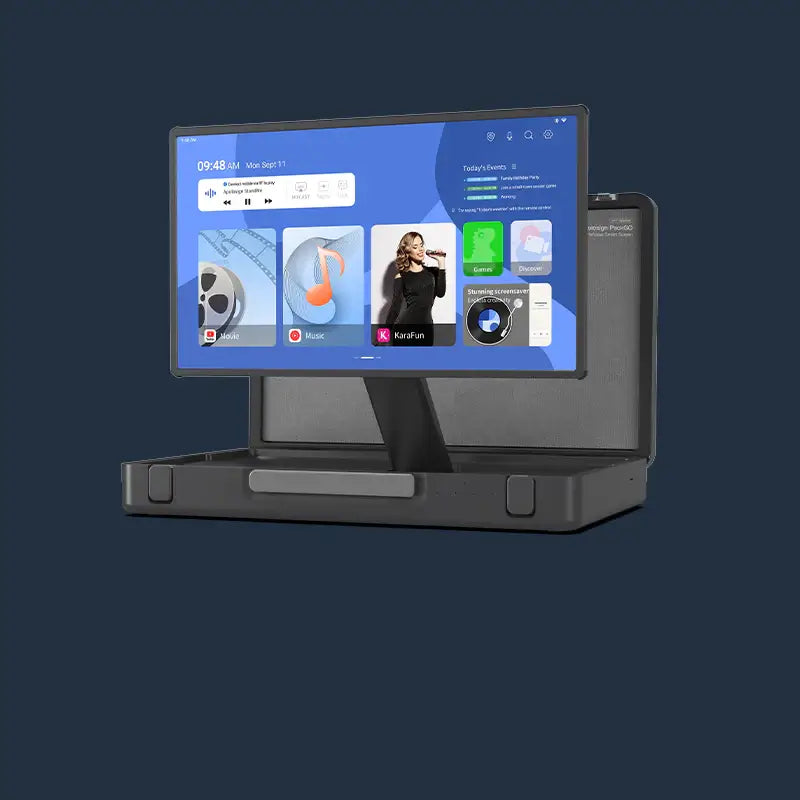
Apolosign PackGo 27" Briefcase Portable TV
The Apolosign PackGo 27" Briefcase Portable TV can be used as a portable HDMI drone monitoring screen, helping teams review live video on a larger display while keeping flight control on the remote controller or mobile device.

From Display Device to Field Operations System Component
On the surface, the Apolosign PackGo 27" Briefcase Portable TV looks like a portable television. In practice, within a drone workflow, its role extends far beyond simple video output—it becomes part of the on-site decision-making system.
Its integrated briefcase design directly addresses one of the most practical challenges in field operations: the gap between transportation and deployment. Unlike traditional large monitors that require stands, mounts, or additional protective housing, the Apolosign PackGo integrates a 27-inch display, power system, and rugged casing into a single foldable unit.
This structure enables true “open-and-use” deployment. Once removed from a vehicle trunk, the unit can be set up immediately without requiring a desk or external stand. This is especially important in roof inspections, temporary field setups, or vehicle-based operations where standard workspace infrastructure simply does not exist.
Equally important is its durability-oriented design. The rigid outer shell protects the display during transport and repeated loading cycles, reducing the risk of damage in mobile workflows. It also allows the system to be deployed directly from a vehicle trunk or tailgate, eliminating dependence on fixed installation structures.
From this perspective, the Apolosign PackGo behaves less like a consumer TV and more like a vehicle-ready mobile display unit.
When choosing an external monitor for drone field work, look for:
- A screen large enough for detail review and team viewing
- HDMI input for stable, low-latency video
- Built-in battery for outdoor or vehicle-based operation
- Brightness and anti-glare support for field visibility
- Protective portable design for transport
- Multiple input ports for controllers, laptops, and accessories
- Easy setup without a desk, stand, or complex mounting system

Why It Works in Drone Monitoring Workflows
The value of the Apolosign PackGo 27" Briefcase Portable TV comes from the combination of multiple capabilities rather than any single feature.
The 27-inch 1080p full HD touchscreen provides significantly more visual space compared to mobile devices, allowing operators to better identify structural cracks, edges, and environmental details. In multi-operator scenarios, it also enables real-time observation and coordination.
A built-in 40W speaker system improves field communication by enabling clear audio output without external equipment, which is especially useful in noisy environments or vehicle-based operations.
The integrated battery system provides up to 6 hours of standalone runtime, making it suitable for short-to-medium field missions without external power. It also supports external power input and output, allowing integration with vehicle power systems or even powering external devices.
With HDMI, USB-A, and USB-C connectivity, the Briefcase Portable TV supports video input, peripheral expansion, and power flexibility, making it functionally close to a lightweight mobile workstation.
How Drone Video Feeds into the System
In practical workflows, drone footage is not transmitted directly to the display. Instead, the remote controller acts as the intermediary signal hub.
For example, with a DJI Mavic 2 Pro, the signal path typically looks like this:
Drone → Remote Controller → HDMI Output → Apolosign PackGo 27" Briefcase Portable TV
The key enabler here is the wired HDMI connection, which ensures low latency, high stability, and independence from network conditions—making it significantly more reliable for commercial drone operations. HDMI Licensing Administrator provides official information about the HDMI specification and interface ecosystem.
Why Wireless Casting Is Not Ideal for Commercial Drone Work
While WiFi-based casting or screen mirroring offers convenience, it introduces several critical limitations in real-world operations: unpredictable latency, signal interference, and potential frame drops in complex environments.
These issues may be acceptable for casual use, but in precision tasks such as roof inspection or structural analysis, even slight delays can lead to incorrect interpretation of live footage.
As a result, professional workflows consistently revert to a more stable architecture: wired HDMI connection + large-screen monitoring. FAA Part 107 rules provide the regulatory framework for many commercial drone operations in the United States.

Setting Up a PackGo Drone Monitoring System
In a typical setup, flight control remains on the remote controller or mobile device, while the Apolosign PackGo 27" Briefcase Portable TV functions purely as an external display terminal.
Once connected via HDMI, the system immediately enters a real-time monitoring mode. This separation of roles—control versus observation—is commonly used in commercial drone operations to improve both efficiency and situational awareness.
The PackGo is designed not as a replacement for the drone controller, but as a dedicated monitoring screen that enhances operational efficiency. In a typical setup, the pilot retains full control via the remote controller or mobile device, while the Apolosign PackGo 27" Briefcase Portable TV serves exclusively as an external display terminal. Once connected via HDMI, it instantly enters real-time monitoring mode, allowing a second operator, client, or inspection team to review live footage on the larger screen. This clear separation of control and observation—a common practice in commercial drone operations—improves situational awareness and streamlines workflow without interfering with flight management.
Real-World Outdoor Performance and Limitations
Display performance is heavily influenced by environmental lighting conditions. The 27-inch 1080p panel, combined with high contrast and brightness, provides strong readability in most environments. However, in direct midday sunlight, visibility can still be impacted, making shaded deployment preferable.
HDMI cabling also requires proper cable management in mobile environments to prevent disruption caused by movement or wind exposure.
The internal battery supports approximately 6 hours of operation and can be supplemented with external power sources for extended field use.
DJI GO 4 Compatibility Considerations
Due to variability in Android system compatibility, DJI GO 4 may not perform consistently across all configurations. As such, it is not recommended to rely on the Apolosign PackGo as the primary flight control device.
A more stable approach is system separation: mobile device for flight control, and Apolosign PackGo for real-time visual monitoring.
Workflow Value: From Single Operator to Collaborative System
The primary value of this setup is not replacement of existing tools, but enhancement of visual capability.
By separating flight control and visual observation, drone operations shift from a single-operator model to a collaborative structure, improving both accuracy and operational safety in complex environments. FAA guidance emphasizes maintaining visual line of sight and awareness of surrounding airspace during drone operations.
Conclusion: Improve Drone Field Monitoring with a Larger HDMI Display
The value of the Apolosign PackGo 27" Briefcase Portable TV in drone workflows is less about adding new functionality and more about redefining the reliability of on-site visual interpretation.
It does not change how drones fly, nor does it integrate into the control system. Instead, it changes how operators perceive and interpret live footage in the field.
In commercial drone operations, this layer of improvement is often more impactful than incremental hardware upgrades—especially in environments with complex lighting conditions, frequent task switching, or multi-operator coordination.
However, whether this approach is truly “better” depends heavily on the use case. Some pilots will still prefer a compact iPad + controller setup, while others may find value in a structured large-screen monitoring station.
So the real question becomes:
In your actual field operations, what matters more—portability, latency control, or high-confidence visual decision-making?
Have you tried using a larger external display as part of your ground station setup? Did it improve efficiency, or introduce unnecessary complexity?
Share your setups and real-world experiences—especially what worked and what didn’t.
If your drone workflow requires clearer live footage, low-latency HDMI monitoring, and a larger screen for team viewing, the Apolosign PackGo 27" Briefcase Portable TV is a practical addition to your field setup.
Explore the Apolosign PackGo 27" Briefcase Portable TV to upgrade your on-site monitoring and decision-making workflow.
FAQ
Q1: What display interfaces does the Apolosign PackGo 27" Briefcase Portable TV support?
It includes HDMI, USB-A, and USB-C ports, supporting video input, peripheral connectivity, and power expansion.
Q2: Does the 27" Briefcase Portable TV support WiFi or hotspot connectivity?
Yes, it supports WiFi and hotspot connections for system-level networking and app usage, though drone video transmission primarily relies on HDMI.
Q3: Does the 27" Briefcase Portable TV support screen casting?
Yes, it supports AirPlay and HDMI casting. However, HDMI remains the preferred option for drone monitoring due to lower latency and higher stability.
Q4: How is the anti-glare and display performance?
It features a 27-inch 1080p full HD touchscreen with 1000:1 contrast ratio and 450 nits brightness, plus rotation support for landscape or portrait viewing. It performs well outdoors, though shaded use is recommended in strong sunlight.
Q5: Does the Apolosign PackGo have a built-in battery and how long does it last?
Yes, it includes an internal battery with approximately 6 hours of runtime and supports external power output for devices such as gaming consoles or accessories.