


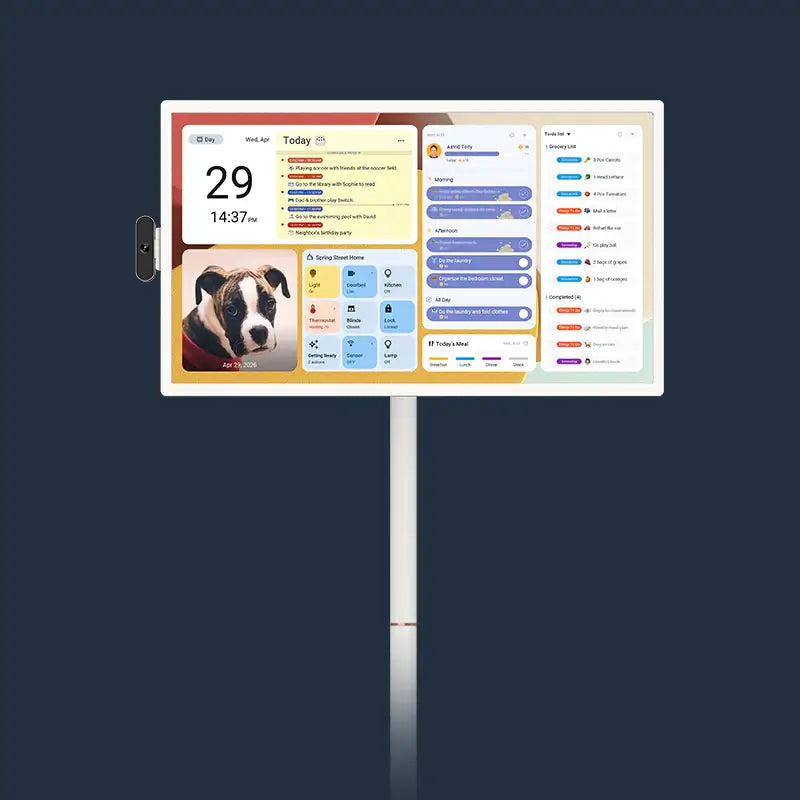
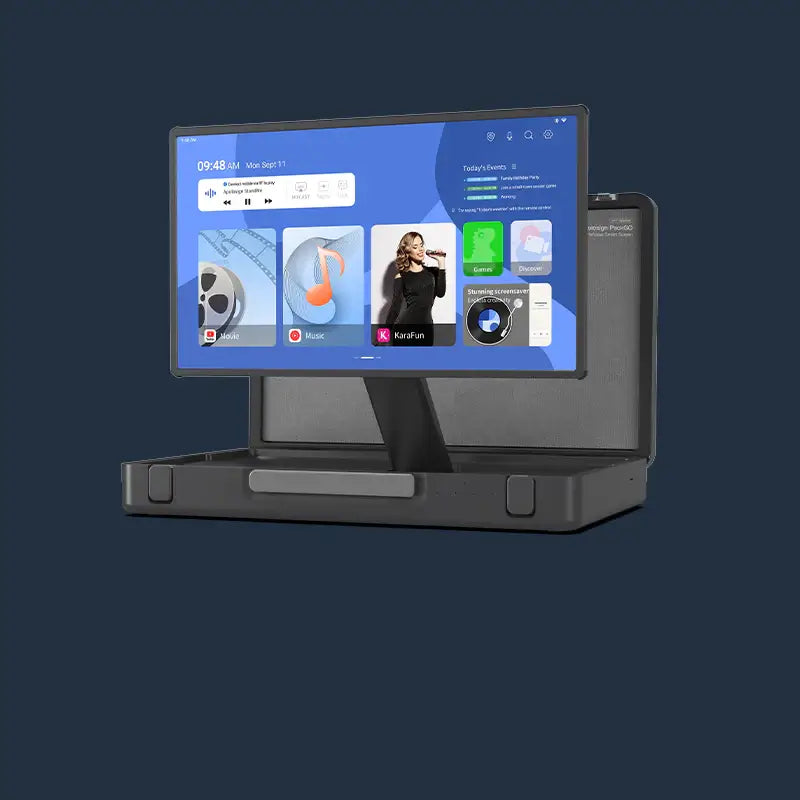



The total cost of a digital family command center comes from five lines, not one price tag: the display itself, mounting or placement, setup and connectivity, any recurring subscription, and future maintenance or replacement. How much a digital family command center costs depends on which of those lines your household actually needs, since a tabletop calendar for one bedroom costs less than a wall-mounted display feeding a busy kitchen.
There is no single number that fits every home. Use the worksheet below to fill in your own amounts, and treat the current 21.5-inch calendar price from Apolosign as one real, time-sensitive example rather than a universal total.
How to Calculate Your Digital Family Command Center Budget
A workable budget adds five lines instead of guessing one lump sum. The formula is simple: display price, plus mounting and cable work, plus setup and connectivity, plus any optional service fee, plus a maintenance or replacement reserve.
| Cost bucket | One-time or ongoing | What you're paying for | What makes it rise or fall | Your amount |
|---|---|---|---|---|
| Display or device | One-time | The screen and its built-in software | Screen size, resolution, and included accessories | $____ |
| Mounting and cable management | One-time | Getting the screen onto a wall or stand cleanly | Wall type, cord length, and whether you hire help | $____ |
| Setup and connectivity | One-time | Wi-Fi, calendar accounts, and initial configuration | Whether accounts and Wi-Fi already exist | $____ |
| Optional software or subscriptions | Ongoing | Extra features some brands charge for | Whether the chosen model needs a paid plan | $____ |
| Maintenance or replacement planning | Ongoing (reserve) | A cushion for repairs or an eventual new unit | Household risk tolerance, not a fixed lifespan | $____ |
The current 21.5-inch price on Apolosign's own page is $379 on sale and $449 at regular price, which fills in the first row for that specific model. It will not match every size or brand, so treat it as a starting anchor and fill in the rest based on your own placement, setup, and service choices.

Display and Placement Set the Upfront Budget
The biggest swing in your upfront number usually comes from whether you reuse a screen you already own, buy a dedicated display, or add a second unit for another room. That single decision affects the device line and the placement line at the same time.
Reusing an old tablet or monitor can shrink the device cost to nearly zero, but only if it can actually display a calendar clearly from across the room. A dedicated display adds a device cost but is built for that job from the start. Tabletop placement usually skips wall work entirely, since you just set the screen on a counter or shelf and plug it in. Wall mounting can improve visibility in a busy kitchen or hallway, but it can also add cable routing or a bracket to your upfront list. Some dedicated calendar displays include a wall-mount bracket in the box, and a few even include a desk stand, which can lower this line without changing the device price. An included bracket still does not cover a difficult wall surface, a missing outlet, or paid labor, so check your actual wall before assuming mounting is free.
Four Sample Budget Scenarios With Stated Assumptions
The five-line formula plays out very differently depending on which starting point you choose. The scenarios below use explicit, labeled assumptions rather than one blended average, so treat each number as a placeholder to swap out with your own.
Scenario 1: Reuse an Old Tablet or Monitor
- Device: $0 (example assumption: a spare tablet or monitor is already sitting unused in a drawer or closet)
- Mounting/placement: $0–$15 (example assumption: tabletop placement or a low-cost stand, no bracket purchase)
- Setup: $0 (example assumption: household Wi-Fi and calendar accounts already exist)
- Ongoing costs: $0 (example assumption: no subscription and negligible added power draw)
- First-year total: roughly $0–$15

Scenario 2: One Dedicated Display for a Single Room
- Device: $379 on sale / $449 at regular price for the 21.5-inch model, sourced directly from Apolosign's own product page
- Mounting: $0 if using the included bracket or desk stand, or $20–$50 (example assumption) if a separate mount or minor cable work is added
- Setup: $0–$50 (example assumption: DIY Wi-Fi and calendar linking) up to $75–$150 (example assumption) if paying someone for setup time
- Ongoing costs: $0 subscription, per Apolosign's current listing, plus an example assumption of $25 set aside as a maintenance reserve
- First-year total: roughly $379–$629, depending on mounting and setup choices
Scenario 3: Two Displays for a Multi-Room Household
- Device: $758 (example assumption: two 21.5-inch units at the $379 sale price each, per Apolosign's page)
- Mounting: $0–$100 (example assumption: one unit placed on a countertop, the other wall-mounted with minor cable work)
- Setup: $50–$200 (example assumption: linking two displays to shared calendars, with some paid help for one installation)
- Ongoing costs: $0 subscription plus an example assumption of $50 combined maintenance reserve for both units
- First-year total: roughly $808–$1,108

Scenario 4: Higher-Spec 27-Inch 4K Display
- Device: $450–$600 (example assumption: no single verified price is available for this size here, so this is a placeholder range reflecting a typical step up from the 21.5-inch model)
- Mounting: $0–$75 (example assumption: wall mounting in a busy kitchen with some cable routing)
- Setup: $50–$150 (example assumption: linking multiple calendars plus chore or meal-planning features)
- Ongoing costs: $0–$30 (example assumption: no subscription fee, but a small reserve set aside for a higher-value unit)
- First-year total: roughly $500–$855
None of these four sketches is a quote for your household. They apply different assumptions to the same five-line formula, so the honest next step is to replace each example number with your own device price, wall condition, and setup effort before treating any total as a real budget.
Setup and Connectivity Can Add to the First-Day Cost
If your Wi-Fi and calendar accounts are already set up, this line stays small. If not, plan for real time spent linking accounts, connecting to Wi-Fi, and getting the display talking to everyone's calendar.
Existing household Wi-Fi and accounts on Google, Apple, or Outlook calendars mean you are mostly configuring an app, not building infrastructure from scratch. A clean wall placement can still need cable planning even when the box includes a mounting bracket, since a bracket does not hide a cord automatically. One review about Apolosign digital calendar noted that getting full functionality running on a kitchen wall took some real setup effort, which is worth budgeting time for even without hiring anyone. Pick your calendar ecosystem and your intended connection path first, then add paid help or extra equipment only if your specific location actually needs it.

When Ambient Visibility Is Worth More Than a Phone-Only Calendar
Ambient visibility earns its cost when people in your house keep missing schedule updates on their phones, not simply because your family is large. If everyone already checks a shared phone calendar reliably, a phone-only setup stays the cheaper, simpler choice.
Digital wall calendars work by taking an existing online calendar and putting it on a screen you can mount on a wall or set on a countertop or table, and some models add chore charts, meal planners, or photo displays on top of that. The value is not automatic. It comes from placing the screen where your family already passes during a real routine, like the kitchen in the morning or the entryway after school. A shared screen in a low-traffic room solves nothing that a phone calendar was not already solving. If your household does not want another device to maintain, sticking with a phone-only calendar is a legitimate, lower-cost choice, not a lesser one.
Which Setup Fits Your Household Size and Schedule?
A small or single-room household usually needs just one central display, while a busy multi-person household or a multi-room home may justify more. The right starting point depends on how many routines actually need a visible reference point.
A small or single-room household, where one central area covers most of the family's comings and goings, typically does fine with one display and a simple placement. A busy household juggling several people's activities, chores, and meals may get more value from a dedicated, interactive display that handles calendars, chores, and reminders in one place, which can justify paying more upfront than reusing an old screen. A multi-room household with distinct morning and after-school routines in separate areas is the case for a second display, but that second unit is really a second full purchase. It repeats the device, mounting, and setup lines from your worksheet rather than adding a small add-on fee, so budget it as its own line item, not a discount extra.
Recurring Services and Maintenance Shape Long-Term Cost
The costs that continue after purchase are subscriptions, connectivity, power, optional paid features, and an eventual replacement reserve, and they do not all disappear just because a device advertises no subscription fee. Our Apolosign calendars currently list no subscription plans for their calendar features, which removes one recurring line from that specific product, but your household's internet bill, power use, and any optional paid extras still belong in your ongoing budget.
A warranty is useful protection against defects, not proof of how long a display will last or what a replacement will eventually cost. The most realistic long-term plan is a short, honest list: any actual recurring fee tied to your chosen product, your existing internet and power costs, and a personal reserve for maintenance or replacement that you set based on how much risk your household is comfortable carrying. Skip inventing a specific lifespan or dollar figure for that reserve since no single number applies to every home or every display.
Apolosign Options for a No-Subscription Command Center Budget
If a dedicated display fits your household after working through the sections above, we currently offer three sizes built around the same no-subscription approach: 15.6-inch, 21.5-inch, and 27-inch 4K. Each one auto-syncs with Google, Outlook, iCloud, and other common calendars, and none of them currently carry a subscription plan for their calendar, chore, or meal-planning features.
The 15.6-inch calendar fits a compact single-display setup best, since its package includes both a wall-mount bracket and a desk stand, giving you tabletop flexibility without buying separate accessories. The 21.5-inch calendar is the size we can point to with a current price example, at $379 on sale and $449 regular, and works well as the one central display for a busy kitchen or entryway. The 27-inch 4K calendar is a screen-area and sharpness upgrade for households juggling more calendars, chores, and meal plans at once, rather than a claim about a lower price tier.
To make your decision, choose whether a compact counter display or a central wall screen matches your main morning traffic path. If you are ready to compare screen sizes and check current package details for your space, explore our digital calendar collection to finalize your line-item numbers.
FAQs
Can a digital family command center have ongoing costs without a subscription?
Yes. A product can have no current subscription fee and still carry ongoing costs elsewhere. Separate the display's subscription terms from your internet bill, power use, any optional paid add-on, and a maintenance or replacement reserve, and record each one as its own line before deciding the total feels affordable.
Should I pay for professional installation?
Not automatically. A tabletop setup or a display that ships with a wall bracket often removes the need for paid labor entirely. Reserve a labor line for situations where your wall surface, cable routing, or outlet placement is genuinely difficult, and decide on your placement first so you know whether that situation applies to you.
How should I budget for maintenance or replacement?
Keep warranty coverage and a replacement reserve as two separate ideas. A warranty protects against defects for a set period, but it does not tell you how long the display will last overall. Choose a personal reserve amount based on how much risk your household is comfortable carrying, rather than assuming a specific lifespan or dollar figure that is not supported by the product itself.