


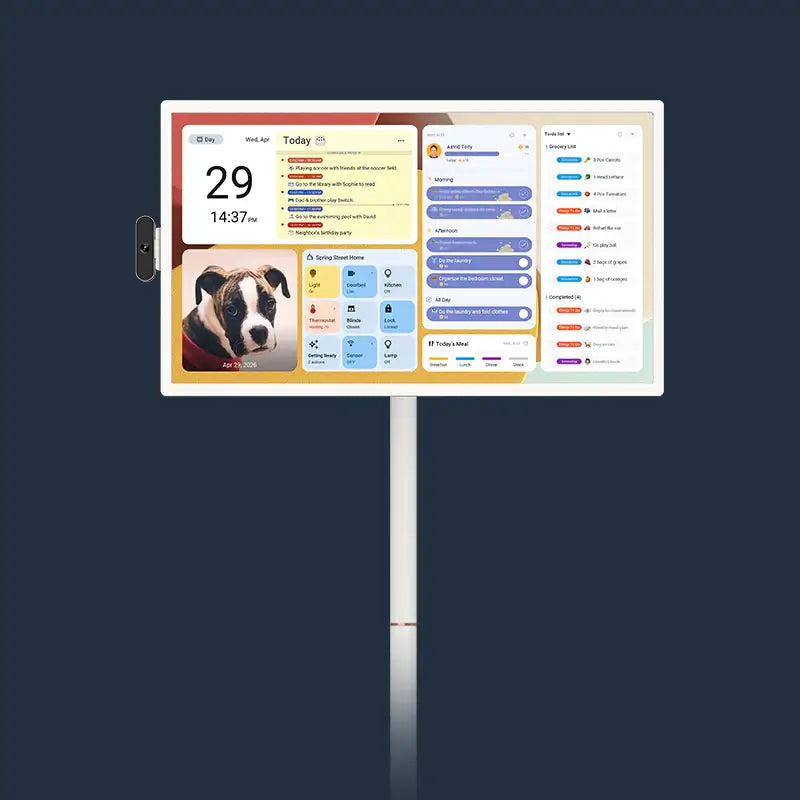
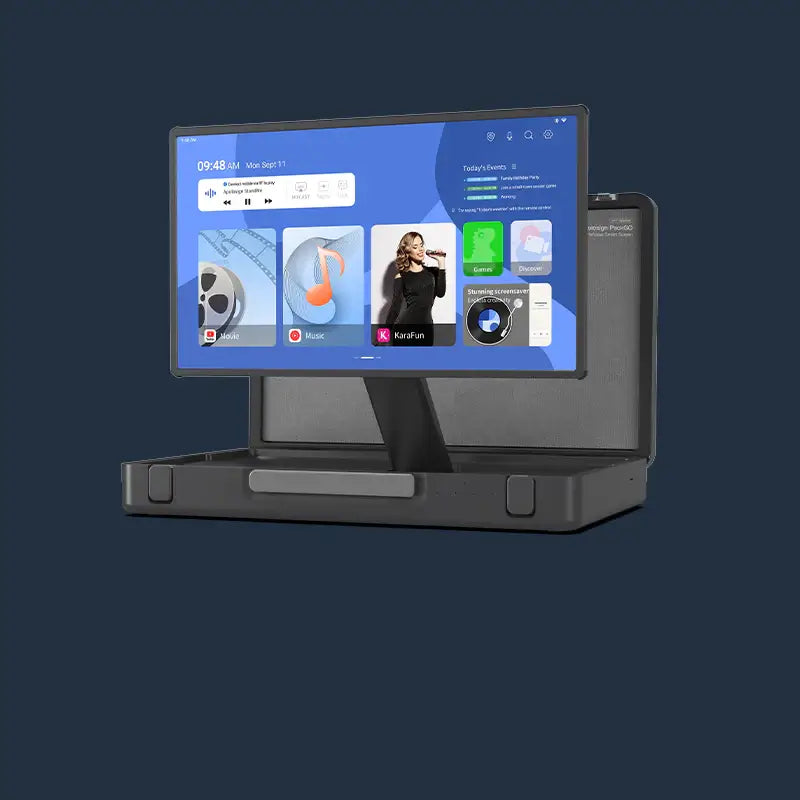
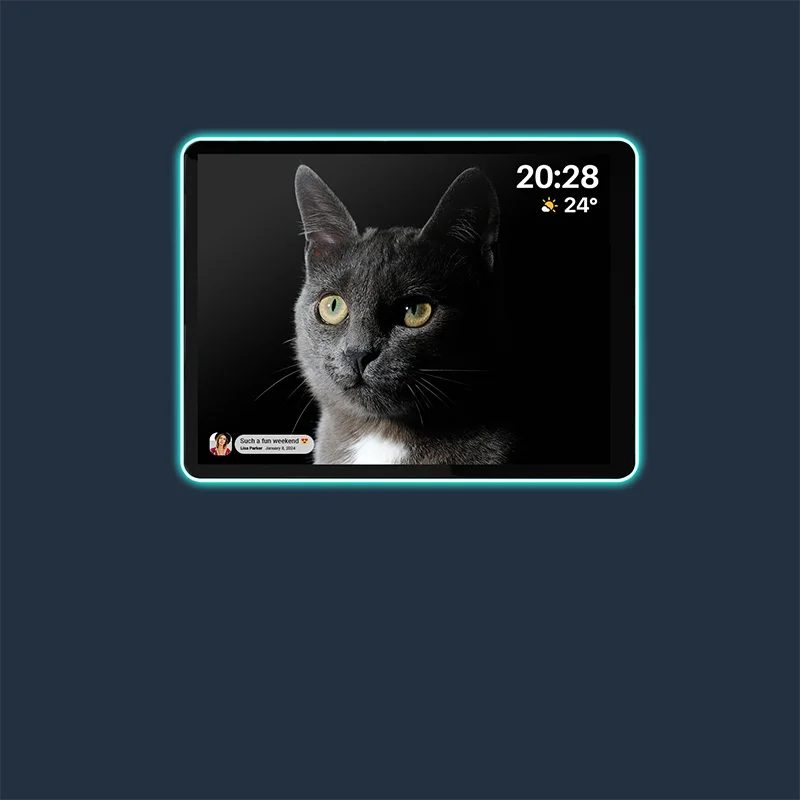


A large digital calendar does more than display dates on a bigger screen. The real advantage is readability: the ability to see, process, and act on your family's schedule in seconds, from across the room, without squinting or scrolling.
This matters for busy households where multiple people need to check appointments, chores, and deadlines throughout the day.
What Makes a Large Digital Calendar Different from a Phone Calendar App?
Most people already have a calendar app on their phone. A large digital calendar serves a different purpose entirely.
Screen Size and How It Changes What You See at a Glance
A phone screen is roughly 6 inches. A large digital wall calendar ranges from 15.6 to 27 inches. That difference changes how much information you can absorb in a single look.
On a phone, a monthly view crams event titles into tiny boxes. You tap, scroll, and zoom to read details.
On a large digital calendar, the same monthly view shows full event names, time slots, and color codes without any interaction. You glance at it while walking past the kitchen, and you know what the day looks like.
This is often called "glanceability," referring to how quickly a display communicates useful information to someone who is not actively engaging with it. A large screen works better for this because the text is bigger, the layout has room to breathe, and the screen does not feel packed with too much at once.
From a Personal Tool to a Shared Family Display
A phone calendar is private. You see your own events, and nobody else in the household benefits unless you send calendar invites or text reminders.
A large digital wall calendar mounted on the wall flips that dynamic. It becomes a shared information hub, visible to every family member who walks by.
- Kids check their after-school schedule.
- A partner confirms a dentist appointment.
- A caregiver sees medication reminders.
The screen does the communicating without anyone needing to ask.
This shift from personal tool to shared display creates new requirements for readability. The text needs to stay legible from 5 to 10 feet away. Color codes need to stay distinct enough for quick identification. The layout needs to separate overlapping events clearly. A phone calendar was never designed for any of this.
How Does a Large Digital Wall Calendar Compare to Paper Wall Calendars?
Paper wall calendars are visible and familiar. But they have structural limitations that affect readability over time.
|
Feature |
Paper Wall Calendar |
Large Digital Calendar |
|
Sync with phone calendars |
No (manual transfer required) |
Yes (Google, iCloud, Outlook) |
|
Edit without mess |
No (cross-outs, erasures) |
Yes (tap to edit, instant updates) |
|
Color coding per person |
Limited (manual markers) |
Built-in, consistent, automatic |
|
Reminders and alerts |
None |
On-screen reminders and countdowns |
|
Readability after changes |
Degrades with every edit |
Stays clean and formatted |
|
Visible in low light |
No (needs room lighting) |
Yes (backlit, auto-brightness) |
Paper calendars lose readability every time something changes. A crossed-out entry, a squeezed-in addition, or a smudged note all make the calendar harder to scan. A large digital calendar resets to a clean layout after every edit, maintaining readability throughout the month.

Why Does Readability Matter So Much for a Large Digital Calendar?
Readability is the bridge between "having a calendar" and "actually using it." A display that is hard to read gets ignored.
What Readability Actually Means on a Calendar Screen
Readability is not the same as "big text." A screen can have large fonts and still feel cluttered, confusing, or hard to scan from a distance. True readability means a person can look at the display for two or three seconds and walk away knowing what the day holds. The speed of comprehension depends on how color, layout, contrast, and text sizing work together on the screen. A larger display gives each of these elements more room to function, which is why screen size and readability are directly connected.
How Poor Readability Leads to Missed Events
When a calendar is difficult to read, people stop checking it. Missed soccer practices, double-booked evenings, and forgotten school events often trace back to the same root cause: the schedule was technically available, but nobody could read it quickly enough to act on it.
A large digital calendar reduces this friction. The information is visible, stays current through calendar sync with platforms like Google Calendar, iCloud, or Outlook, and is formatted for fast comprehension. That visibility is why readability matters for families.
What Visual Features Make a Large Digital Calendar Easy to Read?
Not all large screens are equally readable. Specific features determine how well a large digital calendar performs in a real home environment.
Color-Coded Calendars for Each Family Member
Color coding is the fastest way to distinguish "whose event is this?" on a shared calendar. On a 6-inch phone, the difference between blue and teal is subtle. On a 21- to 27-inch wall display, those colors are far easier to tell apart.
Effective color coding also supports households with three, four, or five individual schedules merged onto one screen. Without distinct colors at a readable scale, a shared calendar becomes a wall of overlapping text.
Font Size, Contrast, and Anti-Glare Display
A large digital calendar on a wall sits in real-world lighting conditions: morning sun through a kitchen window, overhead lights in a hallway, dim evening glow in a living room. Several display features directly affect readability in these situations.
|
Feature |
Why It Matters for Readability |
|
Anti-glare matte glass |
Reduces reflections so text stays clear in bright kitchens and sunlit rooms |
|
Auto-brightness adjustment |
Adapts screen intensity to ambient light, preventing washed-out text during the day or harsh glare at night |
|
High-contrast text display |
Keeps event titles and times legible against both light and dark background themes |
|
1080p or 4K resolution |
Produces sharper text at larger screen sizes, preventing blurry edges on smaller fonts |
These features separate a readable large calendar from a screen that happens to be big but is still hard to read.
Day, Week, and Month Views on a Big Screen
A large screen makes every calendar view more functional. The monthly view shows the full picture without cutting off event names. Weekly view displays time blocks with enough vertical space to see overlapping appointments. Daily view can show detailed notes, locations, and reminders alongside the schedule itself.
On a phone, switching between views always involves a compromise: you gain detail in one view but lose the bigger context in another. A large digital calendar holds enough screen space to show both context and detail at the same time with minimal scrolling.
Who Benefits Most from a Large Digital Wall Calendar?
A large digital calendar is not for every household. But certain living situations gain measurable value from one.
Busy Families Managing Multiple Schedules
Families with school-age children often manage four or five overlapping calendars: work meetings, school events, sports practices, medical appointments, and social plans. A wall-mounted large digital calendar puts all of these on one visible screen. No group texts asking "what time is practice?" No sticky notes on the fridge that fall off by Wednesday.
Seniors and People with Low Vision
For older adults, a 15.6- to 27-inch touchscreen with large fonts and high contrast can replace the struggle of reading a paper calendar or navigating a phone app with small icons. Caregivers can update the calendar remotely through synced apps, keeping medication schedules and appointments accurate without requiring the senior to enter data manually.
Home Offices and Small Teams
A wall-mounted calendar in a home office provides passive awareness of deadlines and meetings. You see it without opening an app or checking notifications. For small teams sharing a workspace, it serves as a lightweight project coordination tool.
How to Choose the Right Large Digital Calendar for Your Home
Picking the right large digital calendar comes down to matching screen size, display quality, and features to how your household operates.
Screen Size by Room and Viewing Distance
A 15.6-inch display works well on a kitchen counter or a child's desk where the viewing distance is under 3 feet. A 21.5-inch screen fits kitchen walls and hallway hubs where family members read it while passing by. A 27-inch display suits open-plan living areas or larger kitchens where the calendar needs to be legible from 6 to 10 feet away.

Calendar App Compatibility
Confirm that the display syncs with the calendar platforms your household already uses, such as Google Calendar, iCloud, and Outlook. Google Calendar usually works best with digital wall calendars, allowing you to add or change events from either your phone or the wall screen. Other platforms connect through imported calendar links and may take a moment to refresh after changes. If your family primarily uses Google Calendar, the sync experience will be the smoothest.
Subscription Costs vs. Lifetime Access
Some large digital calendar products charge annual fees for features like chore charts, meal planning, or calendar sync. Others include all core features with the initial purchase and charge nothing afterward. Check what is included before buying, because subscription costs add up over multiple years of ownership.
The Apolosign digital calendars include calendar sync, chore charts, reward systems, photo display, and voice control with zero subscription fees.

Find the Right Large Digital Calendar for Your Family
A large digital calendar improves readability by giving your schedule the screen space, visual design, and display quality it needs to be useful every day. Color coding becomes distinct. Text stays legible from across the room. Edits stay clean. And every family member can check the plan without picking up a phone.
The Apolosign digital calendar is available in 15.6", 21.5", 27", and 27" 4K sizes with anti-glare matte glass, 1080p/4K resolution, and zero subscription fees for all core features.
FAQs About Large Digital Calendars
Q1: Can I Use a Tablet as a Digital Wall Calendar?
You can, but a dedicated large digital wall calendar offers advantages a tablet cannot match. Screens range from 15.6 to 27 inches (versus 10 to 13 inches for most tablets), anti-glare glass performs better in bright rooms, and the software is purpose-built for shared family scheduling.
Q2: Do Large Digital Calendars Need Wi-Fi to Display Events?
Yes, Wi-Fi is required for syncing events from cloud-based calendar apps. Previously synced events and locally stored content like photo screensavers typically remain visible without Wi-Fi, but real-time updates depend on an active internet connection.
Q3: Do Large Digital Calendars Help Reduce Phone Screen Time?
They can. A visible wall display lets family members check schedules without unlocking a phone, which avoids the notification distractions that typically follow a quick calendar check on a mobile device.
Q4: Where Should You Mount a Large Digital Calendar for Best Visibility?
Mount it at eye level on a high-traffic wall away from direct window glare. Kitchen walls near the dining area, entryways, and home office spaces are the most effective spots for daily visibility.