


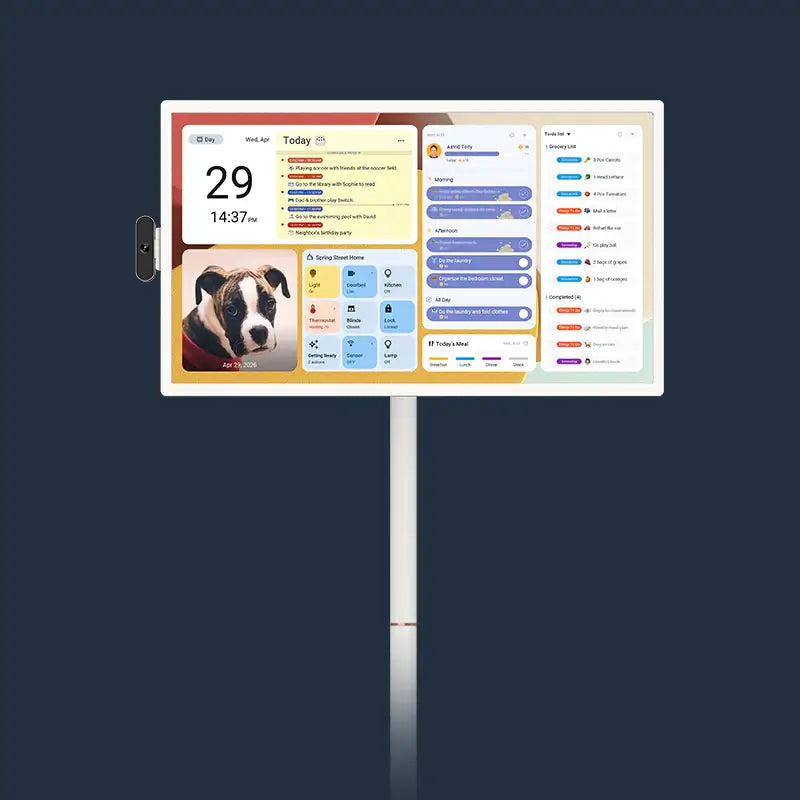




If your family shares one kitchen, entryway, or hallway that almost everyone passes every day, one large family calendar is the better starting point. If your household splits across separate floors, exits, or routines with no shared route, multiple smaller screens are worth considering, but only to fix a specific missed-viewing problem. If everyone already checks a phone calendar reliably, the smartest move is to skip buying a screen at all for now.
The right call depends less on family size and more on where people actually walk each morning, who updates the schedule, and whether a phone calendar is already being ignored.
One Large Family Calendar or Multiple Screens: The Choice Split
Start with your household's daily traffic pattern, not your budget. The table below shows which starting point fits each common family situation.
| Household pattern | Better starting point | Why it changes the choice | Unresolved condition |
|---|---|---|---|
| One shared route (kitchen, entryway, mudroom) | One large screen | A display seen by nearly everyone becomes the default reference point | None if the location stays consistent |
| Separated routes (different floors, exits, schedules) | Consider multiple screens | A central screen may go unseen by part of the household | Only justified if a specific missed-viewing point exists |
| Phone calendar already works for everyone | Defer the purchase | A new screen adds a device without changing who sees the schedule | Revisit only if a visibility gap appears later |
Placement matters more than screen count. Consumer Reports found that a digital calendar tucked away from the household's normal path gets used far less than one placed where the family naturally gathers, which is usually the kitchen. That single finding is the real starting rule for this whole decision.

Choose One Large Screen When One Shared Route Is Real
One large screen earns its place when most of your household passes the same spot every day. It becomes the shared reference point that phone calendars rarely achieve on their own.
A Shared Morning Route Makes One Screen Easier to Use
Picture a family where everyone grabs breakfast, backpacks, and coffee in the same kitchen before school and work. That kitchen counter or wall is already part of the daily routine, so a calendar mounted there gets seen without anyone needing to remember to check it. The recommendation here tracks the route, not the number of people in the house. A family of three with one strong shared path benefits the same way a family of six would.
A Central Display Works Best When One Person Manages Updates
Many households have one parent or guardian who enters most appointments, practices, and reminders. A single large screen lets that person update in one place while everyone else simply glances at the wall on their way out the door. The screen does not remove the work of entering information correctly. It just gives that work one visible home instead of leaving it buried in an app nobody else opens. For more on why size and placement affect daily use, see our guide on large digital calendar setups.

Choose Multiple Screens When Daily Routines Split
Multiple screens make sense only when a central display genuinely cannot cover your household's routines. They are a conditional fix for a named gap, not an automatic upgrade.
Separate Floors Can Create a Genuine Visibility Gap
If one parent works from a home office on a different floor, or teenagers spend most of their time in a bedroom wing far from the kitchen, a single central screen may simply never get seen by everyone. That is a real physical access problem. A second screen placed on the missed route can close that specific gap. A bigger house alone is not proof that more screens are needed; the gap has to be one you can point to and describe.
Do Not Add a Second Screen Just to Duplicate the Same View
Buying a second unit that shows the exact same information as the first, in a spot people rarely use anyway, mostly adds cost and one more device to manage. Before adding a screen, confirm the exact synchronization behavior, power access, mounting spot, and total cost for the specific units you are considering, since those details vary by product and are not something a general buying guide can promise. The practical next step is mapping the actual gap first, which the later section in this guide walks through.

Decide Who Will See and Update the Schedule
Screen count matters less than who owns the schedule. Settle that question before spending more on hardware.
Give One Person Clear Ownership of Updates
Pick one person, or a simple shared rule, for who enters new events and changes. This keeps the calendar accurate instead of stale, whether you end up with one screen or several. A screen does not resolve conflicting entries on its own; it only displays what has been entered, so the ownership rule matters just as much as the hardware.
Separate Viewing Needs From Editing Needs
Some family members only need to glance at the schedule, while others need to add or change it. A large central display suits a household where most people are viewers and one or two people are editors. Adding more screens changes where the schedule can be seen, but it does not by itself resolve who is responsible for keeping it current. For household members who already check a phone calendar without issue, that habit can stay exactly as it is.

Map the Home Before Adding Another Screen
Before buying anything, sketch how your family actually moves through the house on a normal day. This short exercise turns a vague budget question into a clear decision.
Trace the Routes People Actually Use
Walk through a typical school, work, dinner, and bedtime day in your head, or literally in your home. Mark every spot where most people pass and pause, and separately mark spots only one person uses. The shared spot becomes your candidate for one large screen.
Make the Smallest Purchase That Fixes the Gap
Compare your map against who updates the calendar and whether phones already work for viewing. If one route covers the household, one large screen is the simplest answer. If you find a specific route nobody else sees, that is your case for a second unit. If neither issue shows up, hold off on buying anything for now.
If One Large Display Fits, Consider Our Apolosign 27-inch Digital Calendar
If your home map points to one shared route, our Apolosign 27-inch Digital Calendar is built for that exact scenario. It is a 27-inch 1080p touchscreen designed to hang in the one spot your family already uses every day, with a wall-mount bracket included in the box.
It syncs with Google, Apple, and Outlook calendars, so the person who already manages your schedule online does not have to re-enter anything. Beyond the calendar view, it includes a chore and rewards system for kids, a customizable dashboard, and a message board for reminders and countdowns, all things that support a household with one shared reference point rather than several disconnected devices. These features are documented for this exact 27-inch model, and they are not evidence that a second screen elsewhere in the home would automatically show the same information. If your map shows a genuine second gap instead, treat that as a separate purchase decision with its own product research.
Conclusion: Buy for the Route Your Family Actually Uses
Choose one large screen when your household shares a kitchen, entryway, or similar route that most people already use every day. Consider multiple screens only when separate floors or exits leave a specific, nameable gap that a central display cannot close, and check the exact setup details for those units before buying. If your phone calendar already works for everyone, deferring the purchase is a legitimate choice, not a missed opportunity.
Map your home's routes first. If that map points to one shared spot, our Apolosign 27-inch Digital Calendar is a straightforward next step for that household. If it points somewhere else, use that specific gap to guide whatever you choose next.
FAQs
Can a shared online calendar replace a second in-home screen?
Not entirely. An online shared calendar covers remote access for someone outside the home, such as a co-parent in a second household, while a resident display solves visibility for people who are physically in the house but do not reliably check their phones. Many families end up using both rather than treating one as a full substitute for the other.
Will multiple family calendar screens automatically show the same schedule?
No. Adding a second screen does not by itself guarantee that both units stay synchronized, share permissions, or handle edits the same way. That behavior depends on the specific product you choose, so check its documented multi-display features, power needs, and update handling before buying a second unit.
When should we skip buying a digital family calendar?
Skip it for now if everyone in the house already checks and trusts a phone calendar without missing events. A resident display is most useful when phone-based access is being ignored or missed, not as an automatic upgrade. You can always revisit the purchase later if a specific visibility problem shows up.