





Put the screen where you can see it from the floor positions and directions your routine actually uses, not where it looks good while you're standing. Then choose the spot that also leaves your mat area and the room's walkways clear. No single spot works in every home, but a quick test from your mat will show you which one works in yours.
Where should you put a screen for yoga or stretching?
Put it in the spot you can see from every floor position that matters in your routine, with the mat area and walkway still open. Here's how to find that spot in your own room.
Start with your routine, not the screen. Lay out your mat and go through the positions you really use, such as seated, on your back, on hands and knees, lying on your side, or standing at the top of the mat. Notice which way your head faces in each one. A spot that looks perfect from standing height can drop out of view once you're on the floor, so the floor is where this test counts.

Next, pick two or three places where the screen could realistically go. From each floor position, look toward each spot. Can you follow the screen without twisting around or losing sight of it? For desk setups, UCLA Ergonomics advises that you place the monitor directly in front of you and avoid a position that makes you bend your neck up or down. That advice is for workstations, not yoga. Still, it's a good reason to favor a spot you face in your main positions over one off to the side.
Pay attention to glare too. If a window or ceiling light washes out the picture from the mat, UCLA's workstation guide has simple position and tilt changes to reduce window and overhead-light glare. Try them before you rule a spot out.
Jot down what you notice for each spot:
| Candidate location | View from planned floor positions and directions | Room tradeoff (glare, open floor area, or household path) |
|---|---|---|
| Spot 1: | ||
| Spot 2: | ||
| Spot 3: |
A spot works when it stays in view from the positions that matter and its tradeoff column stays short. If an important view is blocked, try the next spot, shift the mat, or turn the screen. Then run the floor test again.
When your routine stays in one position or moves through several
How much your routine moves decides how many views the screen has to cover. A routine that stays put needs one strong sightline. A routine that moves needs a spot that works across several views, and sometimes a tradeoff.
Picture someone doing a 20-minute seated stretching routine who faces the same wall the whole time. That person only needs one thing: a clear view from the main seated position. The best choice is the spot that looks easiest from there, even if it would look awkward from other parts of the room. Other angles don't matter because the routine never uses them.
Now picture a flow that goes from standing, to lying on your back, to lying on your side, with the body turning toward different walls. Here, one clear view isn't enough. Choose the spot that stays visible from the most planned positions. If none covers every one, name the view you'll miss, such as "lying on my right side facing the couch." Then pick a fix: rotate the mat, move the screen closer to the end of the mat, or plan to follow the audio for that short part. Knowing the gap ahead of time beats finding it halfway through a session.
In a shared room, keep the mat and household path in the decision
In a room other people use, the best spot is the one that keeps both your mat area and the everyday walkway clear. A spot with a perfect view can still be the wrong choice if it blocks the room.
Think about a living room that doubles as the path to the kitchen. The ideal viewing spot might sit right where people walk through, or where kids play after school. A screen there means people squeeze past the cord, or you have to stop mid-stretch so someone can get by. That changes the decision. Choose a spot that's slightly less ideal for viewing but keeps the path open, then move the mat a little to improve the angle.

If you're not sure what will fit, draw a scaled floor plan and block out the couch, tables, mat, and walkway. You'll see quickly which candidate spots leave room for everyone.
When no permanent spot works, a temporary setup can. It only makes sense if the screen can move out of the way after each session and go back in place without much effort. If you're thinking about a movable screen for this, our guide to portable TVs for entertainment covers things like stands and battery power.
Check the screen's full footprint before choosing its spot
The space a screen takes up is more than its screen size. A label like "32-inch" describes the display's diagonal, not the full width, height, and depth of the unit.
Before you settle on a spot, compare these details with the space you measured:
- Full external size: width, height, and depth of the whole unit, including the frame.
- Stand or base footprint: how much floor or tabletop it covers, and whether that area sits outside your mat zone and the walkway.
- Adjustment: whether height, tilt, or rotation lets you aim the screen toward your floor positions.
- Power reach: whether the cord gets to an outlet without crossing the mat or the walkway. A cord stretched across either one is a tripping hazard, so pick a different spot or outlet.
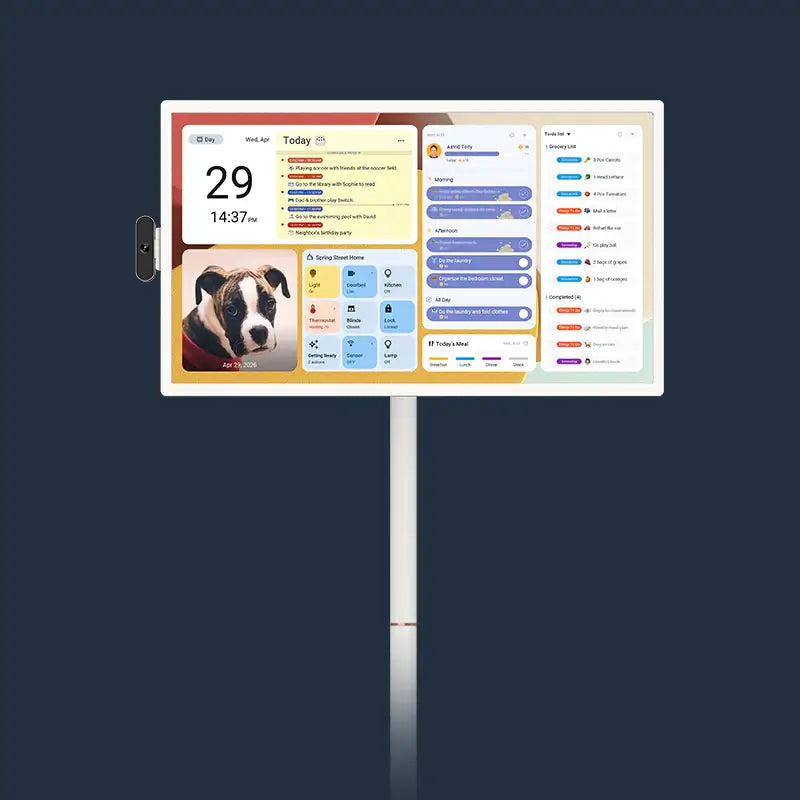
If you're shopping in our portable TV lineup, use the overall screen dimensions page next to your room notes. Our portable TV setup videos show how the stand goes together, which helps you picture the base in your space.
To sum up, a routine that stays mostly in one position in a room with open floor can use one fixed spot facing that main position. A routine that changes direction, or a room other people share, needs a spot that covers your key views and can be reset without blocking the path. Either way, the rule is the same: choose from the floor, not from standing. Next time you practice, do your full routine with the screen in its new spot and note any moment you lose sight of it. Then adjust.
FAQs
How high should the screen be for floor yoga?
There's no one right height. Look at the screen from your lowest position, like lying on your back, and from your highest, like standing. Choose the height and tilt that let you follow along from both without craning. If you can only get one of them right, favor the position where you spend the most time.
Can I use a phone or tablet instead of a bigger screen?
Yes, and the same floor test applies. If you can't make out the instructor's movements from your farther positions, move the device closer to the mat or try a larger screen. Our portable TV versus tablet comparison explains how the two differ for shared viewing at home.
What if two people practice together?
Each person should look at the screen from their own mat. Setting the mats side by side, facing the same direction, usually makes it easier to share one spot than setting them head to toe. If one person always loses the view, swap mats or turn the screen toward the middle.
Do I need to redo the test if my routine changes?
Only for the new parts. If a new routine adds positions or faces a different wall, test the screen from those new spots. Keep the current setup if they still have a clear view, and adjust only if one of them doesn't.