




A family calendar reminder should go off when the person responsible needs to start the first task, not at a fixed time before the event. That task might be packing a bag, signing a form, getting changed, or walking out the door. Work backward from the event start to that moment, and the gap between them is your lead time.
Set the Reminder for the First Action, Not the Event Start
The event start tells you when to arrive. Your reminder should go off earlier, at the moment the first job has to begin.
To find that moment, ask one question: what is the first thing someone has to do that can't wait until the event starts? Then use your household's real start time for that task. Lead time is simple math: event start minus first-action start.
Here is a hypothetical example. Soccer practice starts at 4:30 p.m. To get there on time, your child has to start changing, finding cleats, and filling a water bottle at 3:40 p.m. Subtract 3:40 from 4:30 and you get 50 minutes, so the reminder goes off 50 minutes ahead. That 50 minutes comes only from these made-up times. Your number comes from your own drive, your own kid, and your own routine.

This is the same backward method the UNC Learning Center planning guide gives students: work back from each due date or exam to plan when to start each task. The guide is written for semester planning, not family events, and it doesn't set reminder intervals. Families can still borrow the method for event prep.
| Situation | First action to anchor | When the alert goes off |
|---|---|---|
| School event that needs supplies | Buying or gathering supplies | While there's still time to shop |
| Permission slip or form | Reading and signing it | Before the due date, with time to finish |
| After-school practice | Changing and loading gear | When getting ready has to start |
| Appointment across town | Leaving the house | At departure time for your usual drive |
| Party that needs a gift | Ordering or buying the gift | While shipping or a store trip still works |
The pattern holds across every row. When the first task moves earlier, the reminder moves with it. An event that only needs you to show up gets a reminder close to departure. An event that needs a form or supplies gets one much earlier.
Use One Alert or a Short Sequence
Use one alert when a single prompt starts everything the event needs. Add a second alert only when there is a second, separate task to start.
A dentist visit is a good one-alert event. Nothing needs to be bought or signed, so the only action that matters is getting out the door. One reminder at the time you need to start getting ready does the job. A second alert at the same task adds noise without adding anything to do.
A field trip works differently. Say the permission slip is due Wednesday and the bus leaves Friday morning. Those are two jobs on two days. The signing alert belongs on Tuesday night or Wednesday morning, and the packing or lunch alert belongs on Friday morning. Each alert names its own action, so nobody has to guess what it means.
A simple test: read the alert out loud. If it asks for the same thing as another alert, cut one. If it asks for a new thing, keep it. On staggered school mornings, that means each person leaving gets their own departure alert at their own time, instead of one shared alert that fits nobody.
Send Each Reminder to the Person Who Needs to Act
A well-timed alert only works if the right person sees it. Assign each reminder to the family member doing that task, on a calendar or alert they actually notice.
The person who adds an event is often not the one doing the work. Picture a Saturday swim meet. Mom puts it on the shared calendar. Dad is driving, and your 13-year-old has to pack the swim bag the night before. The packing alert should go to the teen on Friday evening. The departure alert should go to Dad on Saturday morning. If both alerts only land on Mom's phone, she becomes the reminder service.
- The person who adds it: puts in the event and decides who owns each task.
- The person who preps: gets the alert for packing, buying, or signing.
- The person who drives or attends: gets the alert for leaving on time.
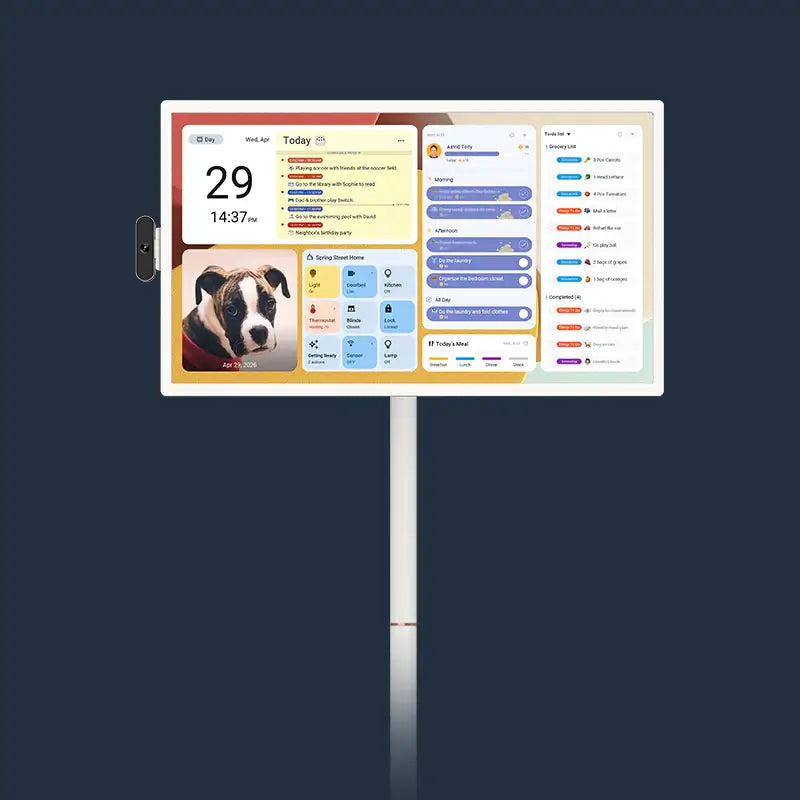
Visibility matters when someone doesn't check the shared calendar. A younger kid without a phone, or a grandparent who drives on Tuesdays, may never see an alert on an app. In that case, decide who passes the reminder along and how the other person shows they got it, such as a quick text reply. A phone calendar is enough when everyone with a task gets alerts there. Some households also keep an Apolosign digital calendar display in the kitchen so people without phones can see the day's plan.
Two-home families need clear ownership more than anyone. Each home may see a different view of the same week, so name who handles the gear and who handles the handoff. Our guide to co-parenting schedule sync covers handoffs and gear in more detail. If several kids share rides, a carpool and practice matrix makes it clear which driver gets each departure alert.
Families have different needs, but the rule stays the same. An event that only requires showing up needs one alert at the time you start getting ready to leave. An event with supplies, forms, or packing may need an earlier prompt for that job, sent to whoever owns it. For your next step, pick one event this week and set family calendar reminders by the first-action time and the right person. A Sunday night reset is a good time to do it for the whole week. If your home needs schedules visible in a shared room rather than tucked inside phones, explore our digital family calendar displays to keep everyone aligned.
FAQs
What should I do with reminders when an event gets rescheduled?
Move the reminder along with the event, then work out the first-action time again. A new time can change the prep. A practice moved from 5:00 to 3:30 might now clash with school pickup, so the alert time and the person who gets it may both change.
What happens to the reminders if an event is canceled?
Delete or cancel the event on the shared calendar so its alerts stop. Then tell whoever owned the prep task, especially if they already planned to shop, pack, or take time off work. A short message keeps someone from showing up to an empty field.
Can a weekly event like practice use the same reminder every time?
Yes, as long as the first action happens at the same time each week. A repeating reminder works for a steady schedule. Change that week's alert when something shifts, like early dismissal, a farther field, or a different driver.
How early should I set a family calendar reminder for something that needs ordering, like a costume?
Anchor it to the last day you can still order and get the item in time, not to the event date. If shipping takes several days, the reminder may fall a week or more ahead. Going to a store instead can move that date later.