






Batch family errands and appointments by mapping the week before it starts. On a Sunday, list every fixed commitment first, then group flexible errands by location so one trip covers several stops. Add real travel time for parking and handoffs, and reserve a few outing windows so the rest of the week stays free for work or home focus time.
We call this routine the Sunday Logistics Mapping Method, and it works for any household juggling school runs, medical visits, and grocery trips. The rest of this guide breaks each step down so you can build your own map this week.
The Sunday Logistics Mapping Method
Start every Sunday map with the commitments that cannot move, then add flexible tasks and one backup plan. This order keeps fixed appointments protected while giving errands room to fit around them.
Start with Fixed Commitments
Write down every school, work, medical, service, caregiving, and transportation commitment for the week first. These are the events that cannot move without real disruption, so they anchor everything else on the map.
- School pickups, practices, and games, with exact times and the driver
- Medical, dental, or therapy appointments, with the address and who attends
- Work meetings or shifts that block travel during the day
- Recurring caregiving or household service visits, such as tutors or pet sitters
Record location and the person responsible for each one. That detail is what lets you build a realistic route window later instead of guessing.

Mark Flexible Tasks and Protected Blocks
Separate movable errands from the fixed events above, then reserve the home or work blocks that need to stay uninterrupted.
- Flexible: grocery runs, returns, pharmacy pickups, and non-urgent errands
- Protected: uninterrupted work hours, homework time, and family dinner
Reserving protected blocks before assigning outings keeps optional trips from creeping into time the household actually needs at home.
Build the First Draft and Add One Contingency
Sketch two or three outing windows around the fixed commitments already on the map, without aiming for one exact number every week. The right count depends on how many appointments and errands the week already holds.
Then add one if-then plan for the disruption most likely to hit this particular week, such as "if the pickup runs fifteen minutes late, then the older sibling starts homework without waiting." Linking a likely situation to a planned response like this can make the next action clearer once implementation intentions are in place, which is useful for the one hiccup every week seems to have.

Clustering Errands for Efficiency
Group flexible errands by geography or purpose so one outing covers several stops instead of several separate trips. Check timing and travel reliability before treating any group as a single outing.
| Task type | Planning input | Cluster decision |
|---|---|---|
| Fixed appointment | Time, location, attendee | Anchors the outing window |
| Nearby errand | Same area, compatible hours | Add to the anchor trip |
| Cross-town errand | Different area, own schedule | Keep as a separate trip unless already en route |
| Time-sensitive errand | Narrow hours or queue risk | Split out if it could delay the anchor appointment |
Group by Route, Not by Wish List
Sort errands by direction from home, school, or work, then combine only the ones that share a realistic path. For stops that are not close by geography, purpose can still justify batching if the trip is already happening for another reason, such as swinging by dry cleaning on the way back from a fixed appointment.
Use a Split Rule When the Route Is Fragile
Split a cluster whenever it forces backtracking, depends on several exact handoffs, or eats into a protected focus block. Accounting for travel-time reliability prevents delays from cascading, so treat traffic and parking variability as part of the route window instead of assuming best-case driving time. Keep a flexible errand separate if its opening hours or a likely queue could push a fixed appointment late.

Managing Family Appointments
An appointment window is bigger than the appointment itself. Build it from the actual drive, parking, check-in, and pickup time so the rest of the day does not slip.
Build the Full Appointment Window
Add the drive there, parking or check-in, the appointment itself, and the pickup or handoff into one occupied block on the calendar. Even a fifteen-minute visit can occupy forty-five minutes once parking and paperwork are counted, so treat the whole block as unavailable for anything else.
Protect the Spaces Between Commitments
Move a flexible errand to another day when the appointment window would crowd a protected focus block or create a late-arrival chain. Look for the next open window that already fits the errand's hours instead of squeezing the same afternoon tighter.
Assign the Handoff
Name the adult or older child responsible for driving, supplies, and pickup for each appointment, and write that name into the shared plan. This step matters most on days already packed with practices and lessons; our after-school transition plan covers how to structure a tight multi-activity afternoon.
Tools to Keep Everyone on Track
Pick the simplest shared source of truth the household will actually check and update. The right tool depends on whether people miss phone updates, not on how many features it has.
Choose the Simplest Shared Source of Truth
A phone calendar is enough when everyone involved opens it regularly and changes reach the right people quickly. If that already happens, keep it. The problem worth solving with new hardware is different: a schedule that lives on someone's phone but nobody sees in the kitchen or hallway where daily decisions actually get made.
Use a Shared Display for a Visibility Gap
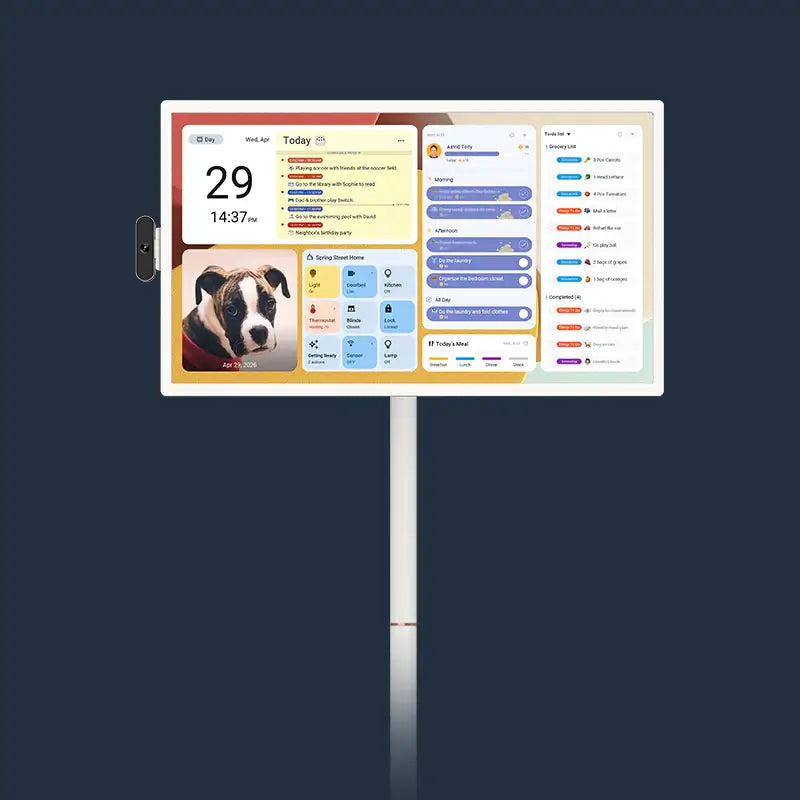
Consider a shared display when the missing piece is a schedule visible in a common room, not another app to check. We built our 27-inch digital calendar to sync with Google, Apple, and Outlook calendars, so the plan you already keep shows up on the wall without extra entry. It also includes a message board for reminders and countdowns, and it can turn chores into a simple points and reward system for kids. For families setting up this kind of shared hub, our guide on a centralized family calendar display walks through the setup, and our piece on no-interrupt focus blocks covers marking protected work time so the display respects it too.

Keep Update Ownership Clear
Whichever tool the household uses, name one person who adds new commitments and one rule for communicating last-minute changes. A display or app only stays useful if someone keeps it current, so treat it as a visibility layer on top of the planning habit, not a replacement for it.
Plan the Week, Then Make It Visible
The Sunday map works the same way regardless of which tool displays it. If your household already checks and updates a phone calendar reliably, keep that setup and skip new hardware.
If the real gap is a schedule nobody sees until it is too late, a common-room display closes that visibility gap without replacing the planning session itself. Start this Sunday by building the fixed-commitment list first, then the flexible tasks, then the outing windows. If common-room visibility is still the missing piece, the Apolosign 27" Digital Calendar is worth a look for keeping that finished plan visible all week.
FAQs
What should we do when a planned errand cluster becomes too tight?
Drop the flexible stop first and move it to the next compatible window, keeping the travel and handoff time around the fixed commitment intact. Shrinking the buffer instead of removing a task usually just pushes the delay onto the next appointment.
How should we batch errands during a week with only a few tasks?
Keep the Sunday reset short: list the fixed commitments, note any flexible tasks, and protect focus blocks as usual. There is no need to invent extra outings just to fill the calendar; a light week can run on one short trip or none at all.
When is it smart to add a flexible errand to an appointment trip?
Attach it only when the errand is close to the appointment, open during that window, and unlikely to delay pickup or eat into a protected block. If any of those three conditions fails, run it as a separate trip instead.
How should we handle a last-minute change to the family schedule?
Update the household's single source of truth right away, tell the people affected directly, and remove the old version so two conflicting plans are not both active. Whether that source is a phone calendar or a shared display, the fix is the same: one place, one current version.