





The smart calendar that helps most with a child’s time blindness is the one whose visual timeline stays on the wall without a monthly bill attached to it. Apolosign pairs an always-visible, color-coded day view with a points-based task system included at purchase, while Skylight keeps part of its day view behind a paid plan and Hearth Display ties its step-based Routines to an active membership from setup. Cozyla comes close but leans more on voice prompts than a spatial view.
What Time Blindness Looks Like on an Ordinary Morning
A ten-minute warning means almost nothing to a child who cannot feel how long ten minutes actually takes. Time blindness, the difficulty sensing how much time has passed or remains, shows up as a kid who says “okay” to a warning about the school bus and then keeps playing, not because they are ignoring the clock but because the gap between now and departure has no shape they can perceive.
A phone or watch timer counts down in numbers, and numbers are exactly the abstraction a child with time blindness struggles to translate into a felt sense of urgency. What tends to work instead is something spatial: a visible block of time shrinking on a screen, the way a glass of water visibly drains rather than a number on a label saying how much is left.

Comparing How Each Display Shows the Passage of Time
The calendars below differ less in whether they show a schedule and more in whether that schedule is built to make time feel physical, and whether that specific feature works without an active subscription.
Apolosign’s Visualized Time Table
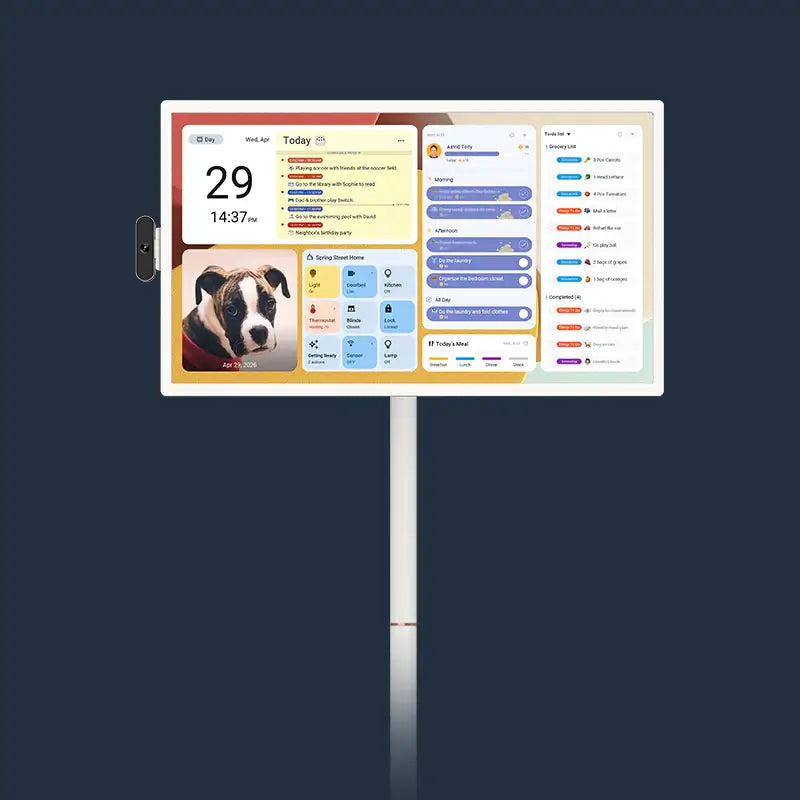
Apolosign’s calendar renders each day as a color-coded, block-style timetable that stays on screen continuously, giving a child something to glance at from across a kitchen rather than something to be told. The timetable, along with calendar sync, meal planning, a points-based rewards system, and photo album uploads, works at purchase with no separate plan required under Apolosign’s current pricing.

Skylight’s Day View
Skylight’s Day View lays out a family’s schedule in a similar block format, and reviewers describe it as clear even for younger kids. The base calendar and day view work on Skylight’s free tier, but the Rewards layer that pairs points with finishing a routine sits behind the Calendar Plus subscription, which Skylight’s pricing pages list at $79 a year.
Hearth Display’s Routines
Hearth’s Routines feature breaks a task sequence into icon-based steps rather than a block of elapsed time, which suits a child who responds better to “what comes next” than “how much time is left.” Hearth’s support documentation states an active Family Membership, at $9 a month or $86.40 a year, is required to finish onboarding and to keep Routines running afterward.
Cozyla’s Cozy Assistant
Cozyla leans on its built-in AI assistant, Cozy, to handle reminders more through spoken prompts than an always-visible timeline. That works well for a household that responds to verbal cues, though it asks a time-blind child to process a countdown by ear instead of by sight, which is a harder translation for many kids with attention-deficit/hyperactivity disorder (ADHD).
Time-Blindness-Relevant Features at a Glance
The table below narrows to only the features that matter for showing a child the passage of time, since screen resolution and speaker count do not move the needle here.
| Feature | Apolosign | Skylight | Hearth Display | Cozyla |
|---|---|---|---|---|
| Always-on color-coded day view | Included | Included on free tier | Icon-based Routines, not a time-block view | Voice-led reminders, limited visual timeline |
| Points or reward feedback tied to the view | Included today | Calendar Plus, $79 a year | Family Membership, $9 a month or $86.40 a year | Included |
| Largest available screen for reading from across a room | 27-inch, 27-inch 4K | 27-inch Max | 27-inch | 32-inch |
| Works without an active subscription | Yes | Base calendar only | No | Yes |
The table points to one pattern that matters most for time blindness specifically: whether a visual, block-style timeline is on screen by default, and whether it keeps working without a renewal. That is narrower than the full picture for ADHD routines in general.

Screen Size Changes How Well a Timeline Reads From Across a Room
Screen size matters when a family calendar needs to be readable from across the room. A larger display makes color-coded schedules easier for children to recognize without walking up to the screen.
| Brand | Screen sizes | Price range |
|---|---|---|
| Apolosign | 15.6", 21.5", 27", 27" 4K | $279 to $679 |
| Cozyla Calendar+ 2 | 15.6", 24", 32" | $349.99 to $1,099.99 |
| Hearth | 27" | $699 |
| Skylight | 10", 15", 27" | $169.99 to $599.99 |
Which screen size makes sense?
- 15.6 inches: A practical fit for a desk, counter, bedroom, or home office where family members will view the calendar up close.
- 21.5 to 24 inches: A stronger fit for a kitchen wall, hallway, or medium shared space where children need to see their color blocks while walking by.
- 27 inches and above: Best for a larger kitchen, living room, or busy family command center where the schedule needs to stay legible from farther away.
The takeaway: Choose the screen size based on where the calendar will hang and how far away children will typically read it. A larger screen can help in a shared room, but the right placement and a clear color-coded layout matter just as much.

Does a Subscription Get in the Way Here Too?
Yes, for two of the four displays, though the specific risk to a time-blindness routine is narrower than the full subscription risk covered elsewhere. Skylight’s day view stays on the free tier, so a lapsed Calendar Plus subscription removes the rewards layer but not the timeline itself. Hearth’s Routines feature, which is the closest thing it has to a time-passage view, stops working entirely if the Family Membership lapses, since that membership is required from initial setup. Apolosign does not attach a plan to their day-view or timeline features today.
None of these displays replace guidance from a clinician or therapist who knows a specific child. They are tools for making an existing routine visible, not a substitute for one a professional has helped design.
Choose the Display That Keeps Time Visible
Start by checking whether the day-view or timeline feature works without a recurring payment, since that is the one variable most likely to break a routine months after purchase. Apolosign’s always-on, color-coded time table, included at purchase alongside its points-based rewards system, gives a time-blind child a spatial cue that does not depend on a card staying on file.

FAQs about Smart Calendars for ADHD Families
Q1: Does a bigger screen automatically help a child with time blindness more?
Not automatically. Screen size only helps once it is large enough to read from where the child normally stands, generally 21 inches or larger for a shared room. Beyond that threshold, the color-coding and layout of the timeline matter more than a few extra inches.
Q2: Can a smart calendar replace a visual timer for a child with ADHD?
It can often do the same job, and sometimes more, since a wall calendar’s timeline stays visible for the whole day rather than one task. A dedicated visual timer still has an edge for a single short task, like a five-minute cleanup, where a compact countdown is simpler than pulling up a full-day view.
Q3: Do these calendars need to be mounted at a child’s eye level to work?
No. What matters more is placement along a path the child already walks, such as a hallway or kitchen, rather than exact height. A display mounted where a child glances at it during a normal routine works better than one placed perfectly but tucked into a room they rarely enter.
Q4: How is time blindness different from simply losing track of time occasionally?
Occasional distraction is normal for most people and passes with a reminder. Time blindness is a more consistent difficulty translating elapsed or remaining time into a felt sense of urgency, common enough in ADHD that many parenting and clinical resources treat it as a distinct symptom pattern rather than ordinary forgetfulness.
Q5: Does a color-coded timeline help ADHD adults as well as ADHD kids?
Yes, the same spatial cue tends to work for adults who experience time blindness, since the underlying difficulty translating elapsed time into urgency does not stop at childhood. Adults typically lean on the day view and dashboard layer more than any points-based reward feature built for chores.